How easy is it to live off-grid?
Since we started living off-grid, we’ve had a lot of people visit us. Many of them say to us “you’re so lucky, we’d love to do something like this.”
It’s very easy, on a day when the sun is shining and the bluebells are in full bloom to idolise living on a farm. Today, as I write this, the sky is blue from horizon to horizon and the autumn leaves are at the peak of their colours. There is no doubt. It is beautiful and we are blessed. But walking in the serenity in the sunlight for a few hours is a different to experience to living it day to day.
On a warm, dry day it is easy for all to be well with the world. The caravan is your bedroom. The whole world is your living room. I love working in the summer, Sitting with my laptop in the woods. When it is cold, or wet, or both, things can feel very different.

What does it look like to live off-grid through a northern-hemisphere year?
Water
Water is the biggest issue. We have running water to a camping block. I don’t think we could survive without this. It is astonishing how much water you get through in a day, to drink, cook with, wash in and so forth. Once a week I run a hose across and refill the tank in the caravan. We only use this for flushing the chemical toilet and washing our hands.
The last couple of winters have been quite mild. The year before that, we had six days when the temperature dipped to below -6°C (21°F) at night, and never made it above 1°C (34°F) during the day. The pipes and the toilets in the camping block froze solid and the only way we could get water was to drive it up from a farm block down the track. It is not something I would like to repeat. We have a put in a small gas heater which can use to keep the edge off should it happen again, but it hasn’t been put to the test.
Electricity
We have quite a lot of solar panels, and batteries. Solar power is a huge topic and I’ll write more about it in some later posts. For now, what I will say is that most people’s expectations of small-scale solar are unrealistic.
In the summer, when there is no shortage of light, solar is great. We can run a fridge, freezer, lights, charge all our devices and have electricity to spare. The winter is a different story. The further north you are, the less daylight you get. A lot depends on the positioning of your solar panels. Ours are on an angle, and south-facing, which is good. The issue is that we are surrounded by woodland. In the winter the sun doesn’t get above the trees and start hitting the panels until mid-morning. By early afternoon, it has dipped too low to be hitting them again. If we've used lots of power overnight a full day's sun is barely sufficient to fully recharge the batteries. And that’s on days with no cloud.

Because the sun is so much higher in the summer, the panels deliver enough power to full charge the system even in a full overcast. In the winter it stands no chance. We have a backup generator to top up the batteries (more on generators in a later blog). We also turn off the fridge and rely on a cool box and the colder weather. We only turn on lights if we need them, and we use usb power banks (like the Jackery above) to charge our devices. Remembering (and finding places) to keep these topped up is a challenge!
Even in the summer, it’s not a great idea to run a hairdryer or airfryer off the solar. We've had visitors do this, and wreck the batteries.
Gas
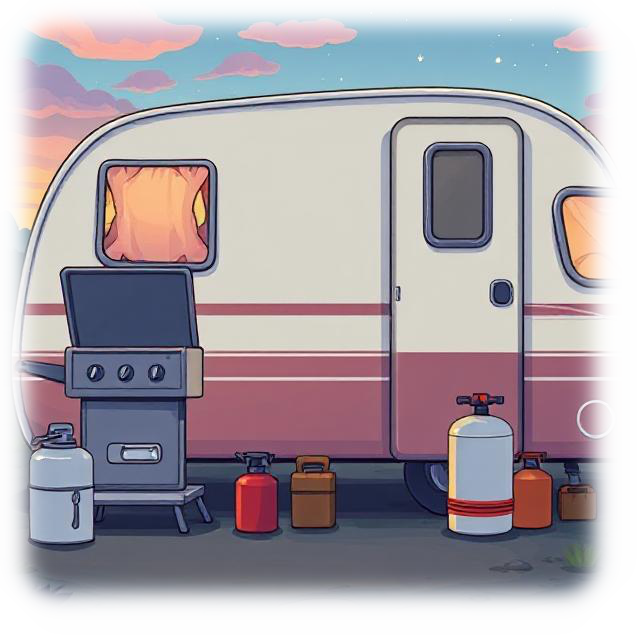
The caravan has gas heating which is great at keeping it warm. When we are around in the winter we keep it on low all the time to prevent the pipes freezing. As the winter progresses we get through gas bottles very quickly, in the summer hardly at all.
Most caravan boilers have a dump valve to empty the water if the temperature gets below 3°C (37°F) to avoid damaging the boiler. If we are going away empty the system and open the taps before we leave.
We made an expensive and potentially dangerous mistake in the first year by using the large 47kg propane cylinders to run the caravan. They work out a lot cheaper per kilogram than the 13kg bottles, so it looked like a no-brainer. What we didn’t realise is that if the top of the bottle is above the gas regulator, the system sucks in liquid propane and choke up the boiler. After a while the pipes get so clogged the gas pressure drops and the heating cuts out. You also run the risk of the whole thing catching fire. Thankfully ours just cut out and we had to pay someone to blow the system out. Twice. We were fortunate to get away without damaging the boiler.
Cooking
We try to avoid using the caravan cooker too much (particularly in the winter) as it causes a lot of condensation. For cooking we use a small butane stove - which gets through a lot of gas. Butane is great in the summer, but in the winter it can struggle as it boils at only -.5°C (33°F). This means if it is very cold, there is no gas to cook with. Even above thus temperature it struggles. Because it is stored as a liquid, the energy it takes to evaporate off cools the bottles. So below about 5°C (50°F) ice starts to form on the outside of the bottle, the evaporation rate slows and the gas pressure dips. Suddenly everything takes three times longer to cook.
And that's not all
There are a lot of other things you learn to deal with, which I'll talk about in later entries.
As you get used to it, you learn to take the rough with the smooth. For us, the benefits outweigh the issues, but it is not something that I'd advise people to get into without thinking it through.