Over the last few entries I’ve talked a lot about life balance, and very little about sustainability. There is a reason for this. I believe that the two feed off each other. It us very difficult to be sustainable if your life is not balanced. Our personal reality affects the way that we think about the world, and our ability to change it. If we don’t understand why we want what we want it becomes very easy to compromise, and once we start doing that it is easy to go off course very rapidly.

In the years I worked for large corporates one of the things which came up consistently was organisational values. They were a buzz-word which came out of the Management Self-Help era, and rapidly gained traction. The big problem with them (as with many other fads) is that when they are dealt with as a bolt-on they make almost no difference. Having also worked in the charity sector I can say from experience there is a huge difference between a values-driven organisation and a profit driven organisation which has attempted to identify values in order change its culture.

The same is true for individuals. You can try and force change, but if it doesn’t bubble out of a genuine deep-down commitment, you will probably fail. Because of this it is vitally important to understand what genuinely makes you tick, before you launch into any idealistic project.
Ikagi
The final tool I want to think about is Ikagi. This is a Japanese life-balance tool which is often used in career advice. It suggests that there are four dimensions to labour. What you love doing, what the world needs, what you can be paid for and what you are good at. If all four of these are in balance you are in a place of Ikagi.
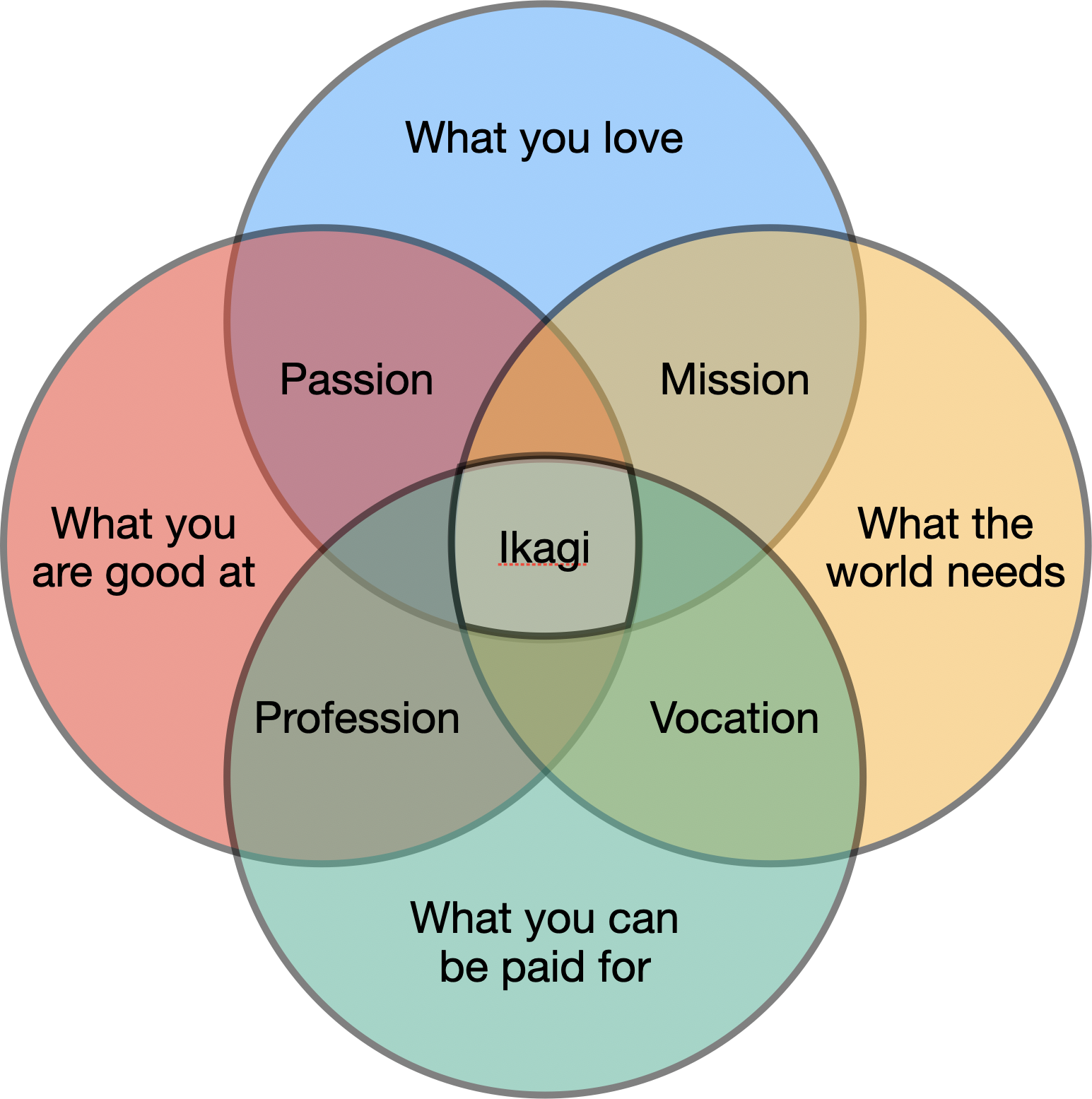
The great thing about the Ikagi model is the prompt that what you love can be part of what you do. For many, we find ourselves stuck in the treadmill of the day-to-day. The feeling is "I have to keep doing this because"... There are people depending on me. I need to pay the bills. Its the only thing that I'm qualified for. And so on. Yet if we are not contented, we are probably not doing our best. If we hate our job, there is a strong chance that is damaging our mental health and souring our relationships.
In using the Ikagi tool, the best place is start at the top. What do we really love. Combining this with what are we good at question gives us our drivig passion, and it is from here that we can springboard into the other two questions.
There is a controversial quotation
“Don't ask what the world needs. Ask what makes you come alive, and go do it. Because what the world needs is people who have come alive.”
Howard Thurman
Like many such aphorisms, the quote contains an element of truth but can also be dangerous. This is not a license to go an do anything you want. But if we really identify what it is that makes us come alive and then use those things in service of others it can be completely transformative.
Making the transition may not be easy, but it is worth the effort. When considering any change, the Ikagi tool is a useful one. Is there a possibility that out there is something we love, are good at, brings good to the world and we can earn a living doing?
Often initially at least it means making less money, but being happier with less is often more fulfilling than being well-paid and depressed. So as we asked in our last post; what's stopping you?