If you are planning to live off grid then it is likely that at some stage you will find yourself installing a solar energy system. A lot of people have misconceptions about what they can expect from solar. We are so used to living in a world where electricity comes on at the press of a switch, most of us don't really think about what is going on when we do.
Solar is almost indispensable for living off-grid, but it has limitations. How much you can get out of it depends on how much you are prepared to spend and where you are located. Over the next few articles we'll be looking at the individual components of a solar system, but before we do it is worth spending a bit of time understanding the basics and defining a few terms.
The diagram below shows the five main components of a solar energy system.
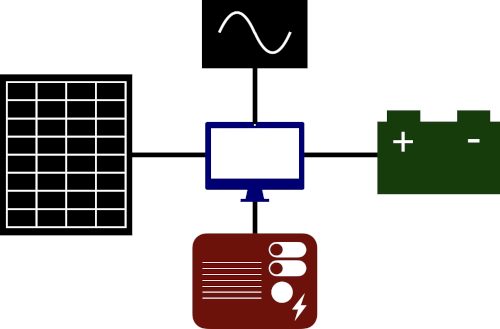
Solar Panel
On the left is the solar panel (or panels). They take sunlight and convert it into electricity. You could get by with just a panel, but there are problems with this. Unsurprisingly solar panel output varies significantly depending on the amount of light hitting it. A cloud comes over, and the output drops. Most things you plug in won't like this. They want a predictable amount. Too much and you can damage them. Too little and they won't work.
So we need something to store the power it generates.
Battery
On the right is the battery, which we use to store the energy generated by the solar panel. This could be a single leisure battery or a bank of several wired together. You can also use smart batteries like the Jackery below which have built in inverters and sockets, but cost more per watt hour.
We'll look at types of battery and layouts in a later post

Controller
In the middle is a controller. This does a number of jobs:
- It regulates the energy coming in from the panels so they don't overload the battery, or overcharge it.
- It regulates the energy coming out of the batteries to provide a uniform supply to anything that you plug in to the system.
- Most controllers allow you to monitor the input or output, and give some indication as to the amount of charge in the battery. Some systems will have just a couple of LEDs, others may give more detailed information as to the exact power coming in and how long the batteries can be expected to last at the current load.
- Some controllers have the ability to define cut-offs to protect your batteries if the charge drops below a set level or a high power item is accidentally connected
- Really clever ones may have usage stats or the ability to connect via wifi
- Some of the larger controllers may have a built in inverter (see below)
The cleverer controllers will need to be calibrated - that means telling them what the type and capacity of your batteries are.
Again I'll look at controllers in more detail in a later post.
Most solar setups will have at least these three. Some panels, a controller and some batteries. The next two items on the diagram are optional.
Generator
At the bottom is a generator. This can be used to top up the batteries if they have been over-used and there is no more light. It can also be used as a backup when power is needed and the batteries are depleted. It is not necessary to have a generator, but it is extremely useful particularly in the winter when more power is needed and less is available.
Inverter
The final component at the top is an inverter. This takes Direct Current (DC) power from the batteries and converts it to Alternating Current (AC) power. You can have a fully functional solar system without an inverter, but if you need to run something which requires AC you will need one.
Pros and Cons of using an inverter
The disadvantage of using an inverter is that every time you convert from DC to AC or back you waste some power.
For example LED lights run off DC. If you plug in directly using a DC USB socket then they only consume the amount they need to run. If you have an inverter running a standard plug socket and you use the same LED light using a power supply, the inverter converts the DC to AC using some power in the process, and the power-supply will immediately convert it back to DC losing power as heat in the process. Additionally most inverters will draw some power even if nothing connected to them is turned on.
The advantage of using an inverter is that some items require AC to run. Either because they actually need it, or because they don't have a DC input.
Useful terms
As many of us remember from school, there are a lot of equations and various different units which describe electricity. These can get quite confusing at times. You don't need to understand most of them, but it is worth having an idea of a few before you dive in. The important units are Watts and Watt Hours
Watts
Watts are a measure of power. Solar panels are sold by how many watts they deliver.
A 120W panel will have an ideal power output of 120 Watts. Ideal because it rarely actually reaches that unless it has direct sunlight at the right angle.
Similarly a phone charger or light bulb will usually tell you how many watts it consumes. An 85W laptop charger will peak at 85 Watts consumption (they generally average less and use less as the laptop approaches full charge).
Hopefully you can already see that a single 120W solar panel isn't going to get you very far. The best you can hope to do is power two sixty watt light bulbs, or one laptop charger and a phone charger. Things like hair dryers tend to be 1000W and kettles or heaters 2000W or more.
Watt Hours
Watt hours are a measure of capacity. A battery system which is 1000Wh can theoretically deliver 1000 Watts for one hour, 100 Watts for 10 hours or 10 Watts for 100 hours.
I say theoretically because there are a lot of other factors:
- Most batteries perform worse in cold weather (which ironically coincides with the time of year you need them the most)
- Many batteries perform worse near peak load - so our 1000Wh battery might happily deliver 100 watts for 10 hours, but may only deliver 1000 watts for forty minutes or less
- Worse still a lot of batteries don't respond well if you fully discharge them and will reduce in maximum capacity each time you do. Many batteries recommend not discharging them below 50%
In an ideal world these two units are the only two units that you need. Sadly most batteries are labelled not in Watt Hours but in Amp Hours, and the battery output is given in volts.
Amps and Volts
Amps are a measure of current (how much electricity is flowing down a wire). Volts are a measure of 'potential' (the pressure required to push the electricity down the wire). Don't worry too much about these as you don't need to understand them to use them. All you need to know is
Watts = Amps x Volts
Watt Hours = Amp Hours x Volts
So of you have a 12V (12 volt) battery and it is listed as 100Ah (100 Amp Hours) its capacity is 12x100 = 1200 Watt Hours.
Similarly a 24 volt system with 140Ah is 24x140 = 3360 Watt Hours
Sizing a solar system
In order to size a solar system you should be able to work out your worst-case power usage and build the system from that number. The trick is to work out what the worst case really is. What is your total load and how long will the system be without light (how many days overcast will there be in winter)?
| Item | Watts | Hours | Wh |
|---|---|---|---|
| Inside lights | 52 | 6 | 312 |
| Outside Lights | 40 | 4 | 160 |
| Laptop | 85 | 2 | 170 |
| Phone x2 | 30 | 2 | 60 |
| Fridge | 120 | 24 | 2,880 |
| Total | 3,582 |
The above table is an example calculation for 24 hours assuming no sunlight. Some items (like lights) can be easy to calculate. Others like Fridges, may require a bit of research. Typically a fridge only consumes power whilst it is running, and it may turn off and on several times an hour.
Use appropriate equipment
If you are going to be living with solar then make sure you use the most efficient equipment. High efficiency light bulbs will reduce your consumption. Get into the habit of reading the power consumption (Watts) of everything you buy. Don't use electricity for cooking or heating. Even a small airfryer can require 1000W.
Our system is quite old and has an inverter and lots of three pin sockets. If I was starting from scratch I would stick with DC, use LED lights, have USB sockets and a DC caravan fridge-freezer. Staying on DC is more efficient, and it prevents visitors from plugging in a hair dryer and killing the batteries (yes we've had that happen). You can still connect an inverter and have one socket hidden away for things that absolutely need it.
The real world is cruel
As we have already seen the numbers of most systems are unrealistic. Solar panels will not average the wattage they specify, batteries rarely achieve the power outage they list, someone will forget to turn off the lights overnight, and you don't know how many days in a row there will be no sun. If you come up with your worst case number, double it and build around that.
Match your components
It is pointless having lots of panels and few batteries - you will charge faster but not be able to store excess power. Equally if you have limited space for panels, having more batteries than they can charge is worthless. Work out a realistic winter's day output from your panels and buy batteries to store that.
It is also worth noting that adding in different kinds of panels or batteries may not be helpful. Most systems work best when all the panels are the same and all the batteries are the same. In some cases adding in an unmatched panel can actually decrease output. Electricity flows from where there is lots to where there is little, so mismatching components can actually end up heating up and damaging unmatched panels or batteries. Modern panels are designed to prevent damage but it is still a waste.
Finally you need to ensure that your controller is beefy enough to cope with the maximum output of the panels and batteries. If you are unsure, a professional solar installer should be able to size your system appropriately but it is always worth asking them to run through their maths to ensure they are not over-selling you.
Maintenance
Once a system is in most people tend to forget about it. To get the best out of it, however, requires looking maintenance. If you don't look after your system it will degrade over time and need replacing more quickly.
- Check how it is doing frequently
- Don't over charge or over drain your batteries (although mistakes happen!)
- Keep solar panels clean.
- Trim trees or remove items which put shadows over your panels
- If you use lead-acid batteries ensure they are regularly topped up with water.
- If you use lithium batteries ensure that they kept in a warm place (lithium batteries charge poorly in the cold, and doing so can damage them)
- If the system is struggling turn lights or freezers off or use a generator to top it up.